


Crossover Components

Intertechnik
Iron core coils
Intertechnik I96/120/085 | 12 mH | 1.05 Ω | 5% | 20 AWG | I-Point Coil
12 mH
1.05 Ω
Orderable
Nov 13.

Intertechnik
Air core coils
Intertechnik Air Therm heat-resistant coil – 2.70 mH | AT92 | DCR 0.59 Ω | Cu 1.32 mm | ±3.0%
2.7 mH
0.59 Ω
Orderable
Nov 13.

Intertechnik
Air core coils
Intertechnik TRI62/1.0/0.50 | 1.0 mH | 0.356 Ω | 1% | 24 AWG
1 mH
0.36 Ω
Orderable
Nov 13.

Intertechnik
Iron core coils
Intertechnik COT62/3.9/14 | 3.9 mH | 0.47 Ω | 5% | 15 AWG | Corotherm Coil
3.9 mH
0.47 Ω
Orderable
Nov 13.

Intertechnik
Iron core coils
Intertechnik DR56/15/132 | 15 mH | 0.531 Ω | 5% | 16 AWG
15 mH
0.53 Ω
Orderable
Nov 13.

Intertechnik
Iron core coils
Intertechnik HQR32/2.7/60 | 2.7 mH | 1.23 Ω | 5% | 23 AWG
2.7 mH
1.23 Ω
Orderable
Nov 13.

Intertechnik
Air core coils
Intertechnik Tritec HQ 40 air-core inductor – 1.50 mH | TRI/DR56 | DCR 0.15 Ω | Cu Tritec 7×0.50 mm | ±3.0%
1.5 mH
0.15 Ω
Orderable
Nov 13.

Intertechnik
Air core coils
Intertechnik LU62/10.0/071 | 10 mH | 3.99 Ω | 3% | 21 AWG
10 mH
3.99 Ω
Orderable
Nov 13.

Intertechnik
Air core coils
Intertechnik LU92/3.9/140 | 3.9 mH | 0.67 Ω | 3% | 15 AWG
3.9 mH
0.67 Ω
Orderable
Nov 13.

Intertechnik
Iron core coils
Intertechnik HQR32/2.2/60 | 2.2 mH | 1.09 Ω | 5% | 23 AWG
2.2 mH
1.09 Ω
Orderable
Nov 13.

Intertechnik
Air core coils
Intertechnik TRI55/1.2/0.50 | 1.2 mH | 0.394 Ω | 1% | 24 AWG
1.2 mH
0.39 Ω
Orderable
Nov 13.

Intertechnik
Iron core coils
Intertechnik DR56/10/140 | 10 mH | 0.371 Ω | 5% | 15 AWG
10 mH
0.37 Ω
Orderable
Nov 13.

Intertechnik
Air core coils
Intertechnik TRI92/1.5/0.50 | 1.5 mH | 0.445 Ω | 1% | 24 AWG
1.5 mH
0.45 Ω
Orderable
Nov 13.

Intertechnik
Air core coils
Intertechnik AT92/330/132 | 3.3 mH | 0.66 Ω | 3% | 16 AWG
3.3 mH
0.66 Ω
Orderable
Nov 13.

Intertechnik
Air core coils
Intertechnik LU62/12.0/071 | 12 mH | 4.39 Ω | 3% | 21 AWG
12 mH
4.39 Ω
Orderable
Nov 13.

Intertechnik
Air core coils
Intertechnik LU92/4.7/140 | 4.7 mH | 0.74 Ω | 3% | 15 AWG
4.7 mH
0.74 Ω
Orderable
Nov 13.

Intertechnik
Air core coils
Intertechnik E106/027/300 | 0.27 mH | 0.04 Ω | 3% | 9 AWG | Choke Coil
0.27 mH
0.04 Ω
Orderable
Nov 13.

Intertechnik
Air core coils
Intertechnik TRI92/0.47/0.80 | 0.47 mH | 0.11 Ω | 1% | 20 AWG
0.47 mH
0.11 Ω
Orderable
Nov 13.

Intertechnik
Air core coils
Intertechnik TRI92/0.68/0.60 | 0.68 mH | 0.21 Ω | 1% | 23 AWG
0.68 mH
0.21 Ω
Orderable
Nov 13.

Intertechnik
Iron core coils
Intertechnik DR56/12/140 | 12 mH | 0.411 Ω | 5% | 15 AWG
12 mH
0.41 Ω
Orderable
Nov 13.

Intertechnik
Air core coils
Intertechnik LU62/15.0/071 | 15 mH | 4.65 Ω | 3% | 21 AWG
15 mH
4.65 Ω
Orderable
Nov 13.

Intertechnik
Iron core coils
Intertechnik I130/1.5/132 | 1.5 mH | 0.14 Ω | 5% | 16 AWG | I-Point Coil
1.5 mH
0.14 Ω
Orderable
Nov 13.

Intertechnik
Air core coils
Intertechnik AT92/390/132 | 3.9 mH | 0.72 Ω | 3% | 16 AWG
3.9 mH
0.72 Ω
Orderable
Nov 13.

Intertechnik
Iron core coils
Intertechnik I130/1.2/132 | 1.2 mH | 0.13 Ω | 5% | 16 AWG | I-Point Coil
1.2 mH
0.13 Ω
Orderable
Nov 13.
Read more: Crossover Components
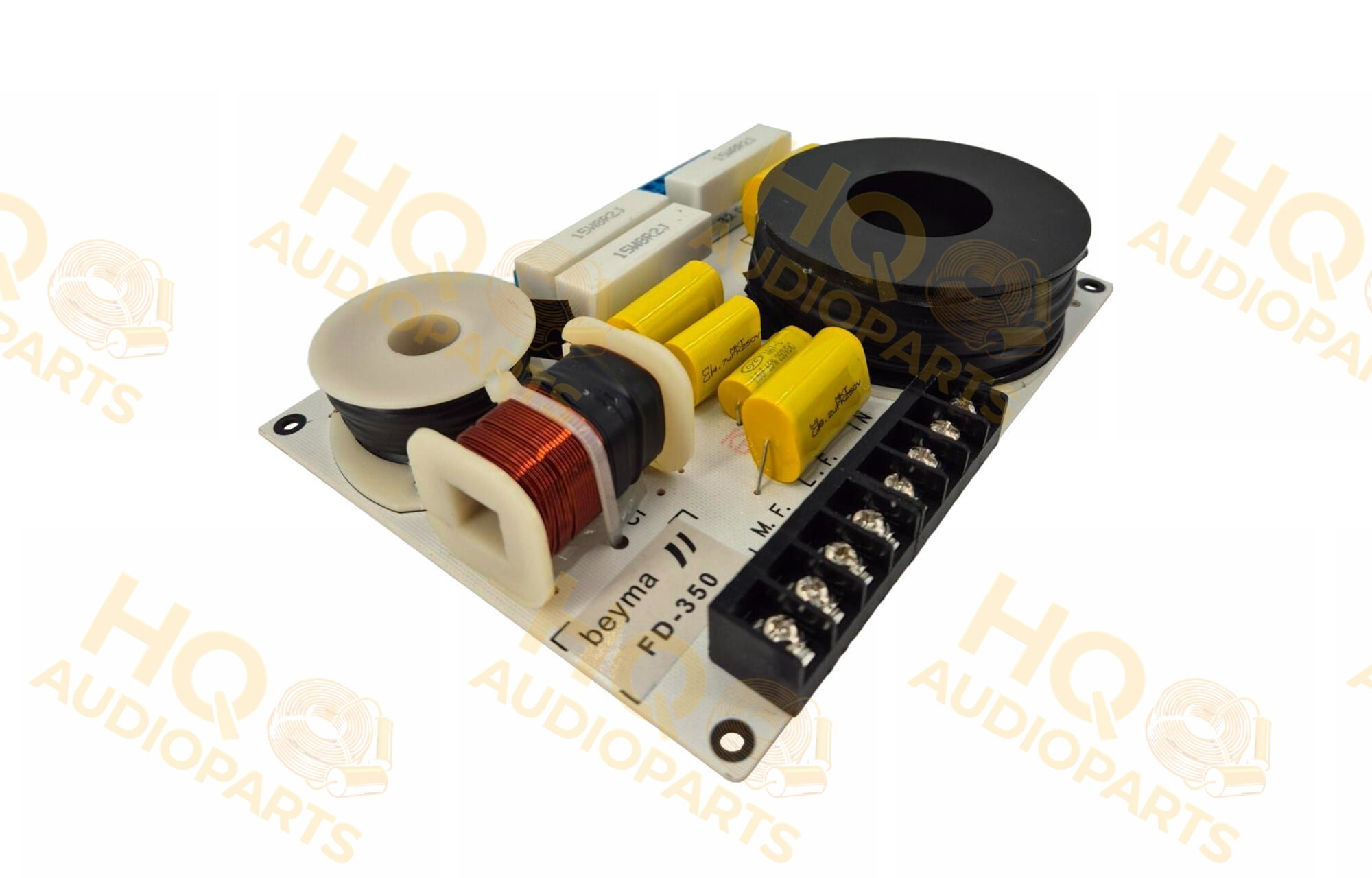
A passive crossover decides which driver gets which part of the spectrum, and where and how steeply the bands hand over to each other. At least half of a well-designed speaker's sound is shaped here, not in the drivers themselves.
This section holds everything a crossover is built from: inductors, capacitors, resistors, circuit boards, driver protectors and ready-assembled networks. When refurbishing, start with aged electrolytic capacitors; for a new design, start by measuring the values precisely.