



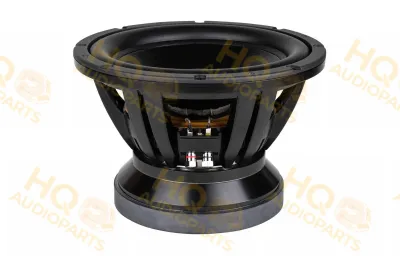
Dayton Audio 12" Ultimax subwoofer kit
Stock details
| Nominal diameter |
Tags
The Dayton Audio 12-inch Ultimax subwoofer kit is aimed at the builder who wants a serious low-frequency driver without having to specify every part of the project from scratch. The Ultimax line is Dayton Audio's long-excursion subwoofer family, designed around a heavy motor and a suspension that stays linear well beyond the point where a general-purpose woofer begins to compress.
A twelve-inch cone is the size most home subwoofer projects settle on, and for good reason. It has roughly forty per cent more radiating area than a ten, so it reaches a given output level with less excursion and therefore less distortion, yet it still fits a cabinet that can be placed beside furniture rather than instead of it. Compared with a fifteen it asks for a considerably smaller box and stays cleaner through the upper bass, which matters if the subwoofer is crossed over above 80 Hz.
Long-excursion drivers of this type are unusually sensitive to enclosure choice, because their compliance and moving mass are deliberately set for small boxes. A sealed cabinet gives the gentlest roll-off and the best transient behaviour, and suits rooms where reinforcement below the tuning point can be relied on. A vented alignment trades that for several decibels of extra output near the tuning frequency, at the cost of a steeper cut-off below it and much less protection against very low frequency content.
Whichever route is chosen, simulate the alignment from the published Thiele-Small parameters before cutting any panels, seal the driver to the baffle properly, and brace the cabinet: at these excursions a panel that flexes will be heard.
No reviews for this product yet.
Bought this product? Sign in to review it quickly!
Sign in to review

Dayton Audio Passive Reference 8" Mini Subwoofer Kit


Dayton Audio Denovo Audio 15" Reference | DIY Kit | Component and Cabinet

SB Acoustics SB12PFCR25-8 Bass-midwoofer

Fosi Audio MC331 Hybrid Tube Amplifier

