




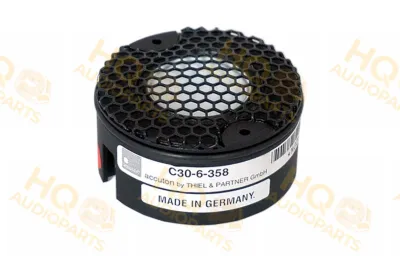
Accuton BD30-6-036 Diamond Tweeter
Stock details
Tags
The Accuton BD30-6-036 is a diamond dome tweeter intended for loudspeaker designs where the high frequency section is expected to disappear rather than to draw attention to itself. It belongs to Accuton's diamond range, in which the dome material is chosen for its extreme stiffness-to-mass ratio rather than for cost or ease of manufacture.
The design work around a driver of this quality is worth doing properly, because a diamond dome exposes crossover errors that a softer tweeter would have masked. The first decision is the crossover frequency. Diamond domes are light and stiff, which is exactly what makes them fast, but it also means there is very little mechanical damping to absorb low frequency energy that a shallow filter allows through. A steeper slope of 18 or 24 dB per octave, set at or above the manufacturer's stated minimum, is the safe and the better sounding choice.
The second decision is level matching. High quality tweeters are frequently more sensitive than the bass or midrange driver they are paired with, and the difference has to be removed with a series resistor or a proper L-pad. Doing this by ear is a false economy: measure the summed response on the finished baffle, because baffle step and diffraction move the balance by several decibels regardless of what the individual driver data sheets say.
Finally, treat the physical mounting with the same care. Recess the flange flush with the baffle, keep sharp edges away from the dome, and align the acoustic centres of tweeter and midrange, either by stepping the baffle or by correcting the delay electronically.
No reviews for this product yet.
Bought this product? Sign in to review it quickly!
Sign in to review

Scan-Speak Illuminator D3004/602010 1" Textile Dome Tweeter

Dayton Audio TD20F-4 3/4" Soft Dome Neodymium Tweeter 4 Ohm

Dayton Audio DC28FT-8 1-1/8" Silk Dome Truncated Tweeter

Peerless by Tymphany BC25TG15-04 1" Silk Dome Tweeter

SMSL PA400 Power Amplifier

Dayton Audio RS100P-4 4" Reference Paper Woofer
