




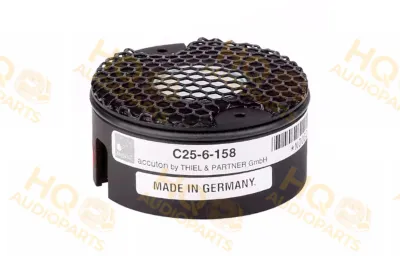
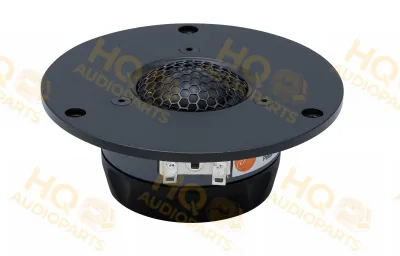
Accuton BD25-6-034 Diamond Tweeter
Stock details
Tags
The Accuton BD25-6-034 is a diamond dome tweeter built for two-way and three-way high-fidelity designs in which the treble is expected to be transparent rather than flattering. Accuton's diamond domes owe their behaviour to the material itself: a stiffness-to-density ratio high enough to push the first break-up mode of the dome clear of the audible band.
Integrating a driver of this calibre is fundamentally a measurement exercise. Manufacturer data is measured on a standard baffle, and the baffle a builder actually uses will differ in width, edge treatment and driver spacing, all of which change the response by amounts that dwarf the differences between individual crossover components. The only reliable approach is to measure the driver in the finished cabinet, at the design listening distance, and to derive the filter from those curves.
Level matching deserves particular attention. Tweeters of this class are typically more sensitive than the midrange or bass driver alongside them, and the excess must be removed with a series resistor or an L-pad before the crossover shape is finalised, since attenuation and filter alignment interact. Getting the order of work wrong means tuning the same network twice.
There is also a listening dimension that measurements alone do not settle. A response that is technically flat on axis frequently sounds slightly forward in a normal room, because a real room adds reflected energy. Many well-regarded designs run a gentle downward tilt across the treble for exactly this reason, and a driver this clean is capable of being tilted without sounding dull.
No reviews for this product yet.
Bought this product? Sign in to review it quickly!
Sign in to review
SB Acoustics Satori TW29RN Dome Tweeter

Scan-Speak Discovery D2606/922000 1" Coated Textile Dome Tweeter


Peerless by Tymphany D26NC56-06 1" Fabric Dome Tweeter

Mundorf MEO-4.70T3.450 | 4.70 µF | 3% | 450 V | Oil

Peerless by Tymphany BC25TG15-04 1" Silk Dome Tweeter

